

Getting Your Rotary Oven to Actually Keep Up
If you’ve ever run a commercial rotary oven, you know the struggle. You’re fighting to get that perfect crust, clicking heaters on and off every few seconds, but the equipment just can’t keep pace. There’s always this annoying lag. By the time the heat actually hits, you’ve already missed your window. That’s why we built our replacement infrared lamps to hit full blast in seconds. No waiting around.
Why speed matters here
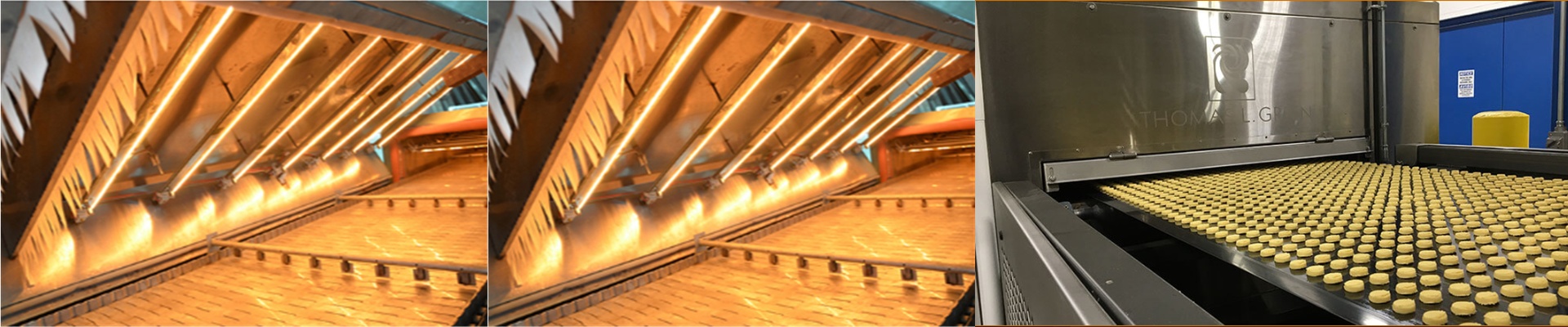
Most heaters waste a ton of time warming up the air around them. It’s inefficient. We use shortwave infrared (SWIR) instead. Think of it like this: instead of heating the room to warm up the food, our quartz tubes send high-energy photons straight into the product. Because the tungsten filament has very little “bulk” to it, it ramps up almost instantly. You aren’t wasting power heating up the metal chassis of your oven—you’re putting that energy exactly where it belongs.
Built for the “On-Off” Grind
Constant power cycling is usually a death sentence for lamps. The rapid heating and cooling creates thermal shock, which snaps filaments and cracks glass. It’s a nightmare. To fix that, we use a high-purity quartz envelope. It can handle the constant expanding and contracting without breaking a sweat. We also spec our filaments to take those power surges without thinning out. Basically, we built them to survive the abuse of a busy kitchen without burning out every few weeks.
A couple of things to keep in mind
These are drop-in replacements. We kept the footprints standard, so you can just wire them in and get back to work without having to rebuild your housing. But a word of warning: this kind of heat is aggressive. Since these lamps react so fast, your PID controllers need to be dialed in. If your sensors are sluggish, you’ll overshoot your temperature before the system even realizes it. You’ll want a fast-acting thermocouple to match the speed of the lamp. We build these tools to take a beating. As long as your power is clean and you keep the grease off your cooling fans, you’ll get a rock-solid heat output and a cycle time that actually keeps up with your workflow.